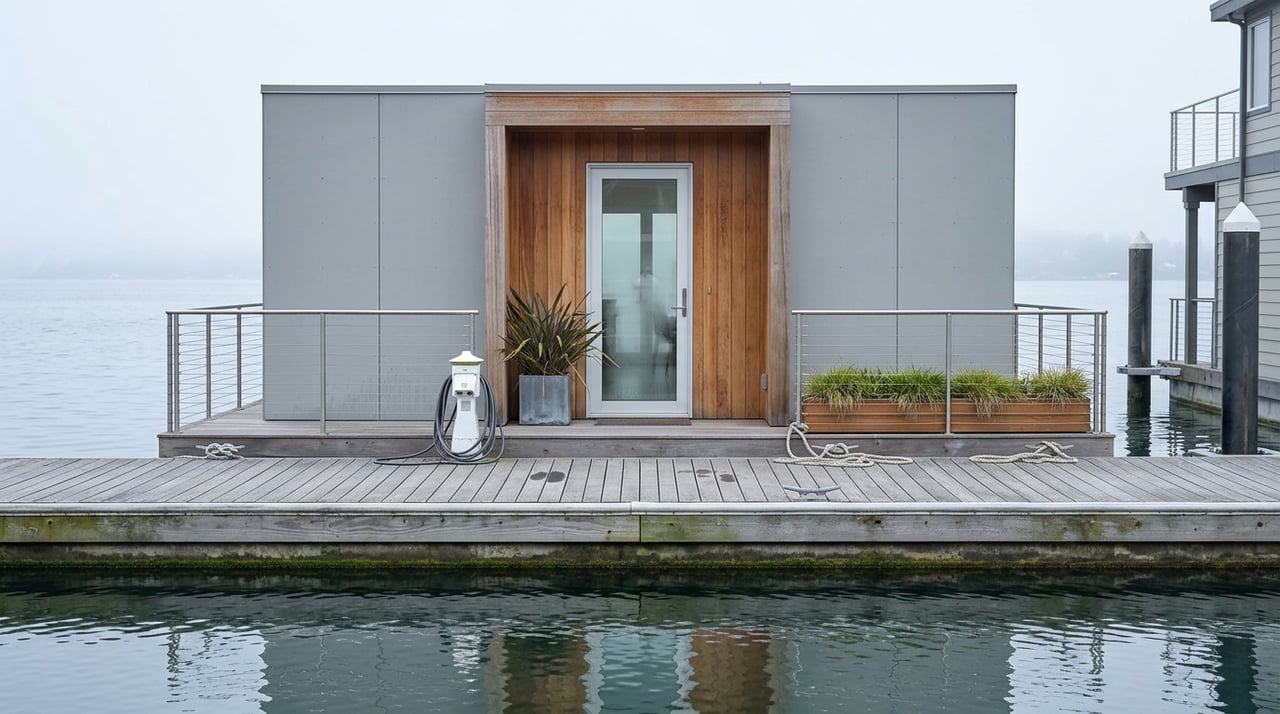
Real Property or Vessel? The Question That Actually Decides Your Sausalito Floating Home Closing
August 20, 2026
August 20, 2026
"If you live in a floating home, you are taxed as a homeowner, not as a boat owner." That single sentence sits on the Marin County Assessor's own page, and it settles a debate that half the agents and escrow guides writing about this market still get backwards.
If you've been reading up on floating homes in Sausalito, you've likely already hit conflicting answers to the most basic question in the transaction: is this a house, or is it a boat? Some sites will tell you a floating home is personal property, titled through the state's housing agency the way the DMV titles a car. Others will tell you it's assessed like any hillside property in Marin. Both claims show up in professional real estate content right now. Only one of them matches what the county that actually collects the tax says about its own rules.
This isn't a minor wording issue. Financing, insurance, and how a lender evaluates the deal all depend on how the property is classified. Buyers researching this market end up with two entirely different mental models of what they're purchasing, and they get there by reading equally confident, equally professional-looking real estate content.
Marin County's Assessor-Recorder-County Clerk office resolves it directly. Under California Revenue and Taxation Code Section 229, a floating home is defined by specific physical criteria, including a permanent hookup to a shore-side sewage system, and once a structure meets that definition, the county assesses it the same way it assesses a house on a hillside lot. Not as a vessel. Not as personal property. As real property, full stop.
That matters for a buyer for a reason that has nothing to do with the tax bill itself: if the classification were genuinely ambiguous, it would mean two different sets of transfer rules, two different disclosure standards, and two different escrow processes depending on which side of the argument your title company happened to land on. The county has already answered the question. The confusion you're reading elsewhere is a market that hasn't caught up to its own regulator.
Here's the part that surprises buyers who assume "real property" means "normal mortgage." It doesn't, at least not in practice. The county's classification determines your tax treatment, not your lender's appetite. Floating homes still trade in a market with a small and specific buyer pool, thin comparable sales, and appraisers who don't get regular reps valuing a dock-tethered structure against a fixed dwelling.
That combination pushes most transactions toward lenders who specialize in this niche, portfolio lenders and credit unions with floating-home experience, regardless of what the assessor's office calls the property. The legal question and the financing question turn out to be two separate problems. Solving one doesn't solve the other. A buyer who walks into escrow having only confirmed the tax classification, and not the lender's specific underwriting appetite for a Richardson Bay berth, can still find the financing timeline stretching well past what a land-based purchase would take.
Layer a second, newer wrinkle on top of the tax question: what happens to your berth lease the moment you buy. California's existing Floating Home Residency Law already capped annual rent increases across Marin, Alameda, and Contra Costa counties at the lower of 5 percent or 3 percent plus the change in cost of living, a rule set to run through January 1, 2030. Marin's floating-home community and its marina owners spent more than two years negotiating a Marin-specific refinement to that framework, and the state signed the result, AB 754, into law on September 3, 2025.
The bill took effect January 1, 2026, and it has been governing Marin's floating-home leases ever since. Its rent provisions apply retroactively to any increase made on or after July 1, 2025, and it extends Marin's rules through January 1, 2038. Marinas were required to update leases for any floating home sold since July 1, 2025, and to convert existing one-year lease terms into 10-year-or-longer terms with rent increases indexed to CPI, with a floor of 3 percent and a ceiling of 7.5 percent, and CPI increases above 5 percent cut in half. That transition window has already closed, so any berth lease you review today should reflect the new structure.
This wasn't imposed on the community from Sacramento. The Floating Homes Association surveyed its own residents, more than 400 of them, a 67 percent response rate, and 93 percent voted in favor of the compromise before the bill ever reached the Assembly floor. Every one of Marin's floating-home marinas signed on. That kind of near-unanimous local buy-in is unusual for a rent-control measure, and it's part of why the law matters for a buyer today: it reflects what the people who actually live on these docks decided they needed, not a generic statewide formula.
For a buyer, the practical takeaway is specific. Ask to see written confirmation that the berth lease has been converted under AB 754's 10-year framework, since the conversion deadline has already passed. A lease that never got updated, or one where the paperwork lags the actual terms being charged, carries different rent-increase exposure than one properly documented, and that difference compounds over a decade of ownership.
Berth costs vary enough between operators that a number quoted for one marina tells you very little about another. Clipper Yacht Harbor's published rate sheet runs from $15 to $33 per linear foot of berth length per month, depending on size and basin. Richardson Bay Marina prices berths at a flat $15.50 per linear foot, with a 26-foot minimum working out to $403 a month before metered utilities.
| Marina | Rate structure | Notes |
|---|---|---|
| Clipper Yacht Harbor | $15–$33 per linear foot/month | Rate varies by berth size and basin |
| Richardson Bay Marina | $15.50 per linear foot/month | $403/month minimum (26-ft berth), plus metered charges |
Neither figure includes the utility metering, gate access fees, or dry-storage charges that both operators bill separately. A buyer comparing two listings on paper, one at Clipper Yacht Harbor and one at Richardson Bay Marina, needs the actual current lease document from each marina to make a real comparison, not a rule of thumb pulled from a blog post.
Sausalito's floating-home community includes marinas like Waldo Point Harbor, a privately owned facility of 282 berths at the northern end of Richardson Bay that has run at effective full occupancy since the 1970s. Waldo Point Harbor's own guidance to residents states plainly that the harbor office does not maintain a list of homes for sale, and that floating home sales are handled directly by the private homeowner, typically through a traditional real estate firm.
That structure means there is no central, marina-run inventory to check. Combine that with a marina that hasn't had an open berth in five decades, and the practical reality is that meaningful floating-home inventory moves through relationships and direct outreach as often as it moves through a public listing. For a buyer serious about a specific dock, that's a market where representation with existing marina relationships and a private buyer network matters more than it would in a conventional hillside listing search.
Before you open escrow, get these in writing:
Is a Sausalito floating home eligible for a conventional mortgage? It depends far more on your specific lender's floating-home experience and the property's individual documentation than on the county's real-property classification. Most buyers still work with lenders who specialize in this niche because of the limited comparable sales pool, even though the county assesses these homes as real property rather than vessels.
Does buying a floating home reset my berth rent? It depends on the lease term. AB 754 sets specific conditions under which a marina may establish a new initial rental rate at the time of an in-place transfer, tied to whether the existing lease runs 10 years or longer. Confirm the exact lease status with the marina before you write an offer.
How do I find out if a specific lease already reflects AB 754's terms? Ask the marina directly for the current lease document and any addenda. The law required marinas to update leases for homes sold since July 1, 2025, but confirming your specific berth's status in writing protects you from relying on a verbal assurance.
A floating home purchase in Sausalito rewards buyers who ask the right questions early and penalizes buyers who assume the paperwork works the way it does on land. If you're weighing a specific dock, a specific marina, or simply want a clear read on where the market and the law currently stand, Emily Schaffer can walk you through it directly. Request a Private Consultation to start.
Stay up to date on the latest real estate trends.




Get assistance in determining current property value, crafting a competitive offer, writing and negotiating a contract, and much more. Contact me today.